Decreto Flussi 2026–2028: Italy’s 497,550 Work Visa Plan
Decreto Flussi 2026–2028 Explained: Italy’s Work Visa Plan
Italy has introduced a major legal migration framework known as the Decreto Flussi 2026–2028, opening 497,550 work visa slots for non-EU citizens over three years. The plan is designed to support Italy’s economy, fill labour shortages, and reduce irregular migration through a structured process.
This article explains what the decree means, who it is for, how the process works, and what applicants should watch out for.
What Is the Decreto Flussi?
The Decreto Flussi is Italy’s official system for controlling the legal entry of foreign workers. It sets annual quotas and defines which sectors can hire non-EU nationals.
In late June 2025, the Italian Council of Ministers approved the new three-year framework covering 2026, 2027, and 2028. The government later confirmed the totals and sector allocations, giving employers and applicants clearer planning timelines.
Total Quotas: The Big Picture
Over the three years, Italy plans to admit 497,550 foreign workers. These are split into two broad categories:
Non-seasonal and self-employed work: 230,550 slots
Seasonal work (agriculture and tourism): 267,000 slots
As a result, seasonal roles make up a slightly larger share, reflecting Italy’s ongoing needs in farming and hospitality.
Year-by-Year Breakdown
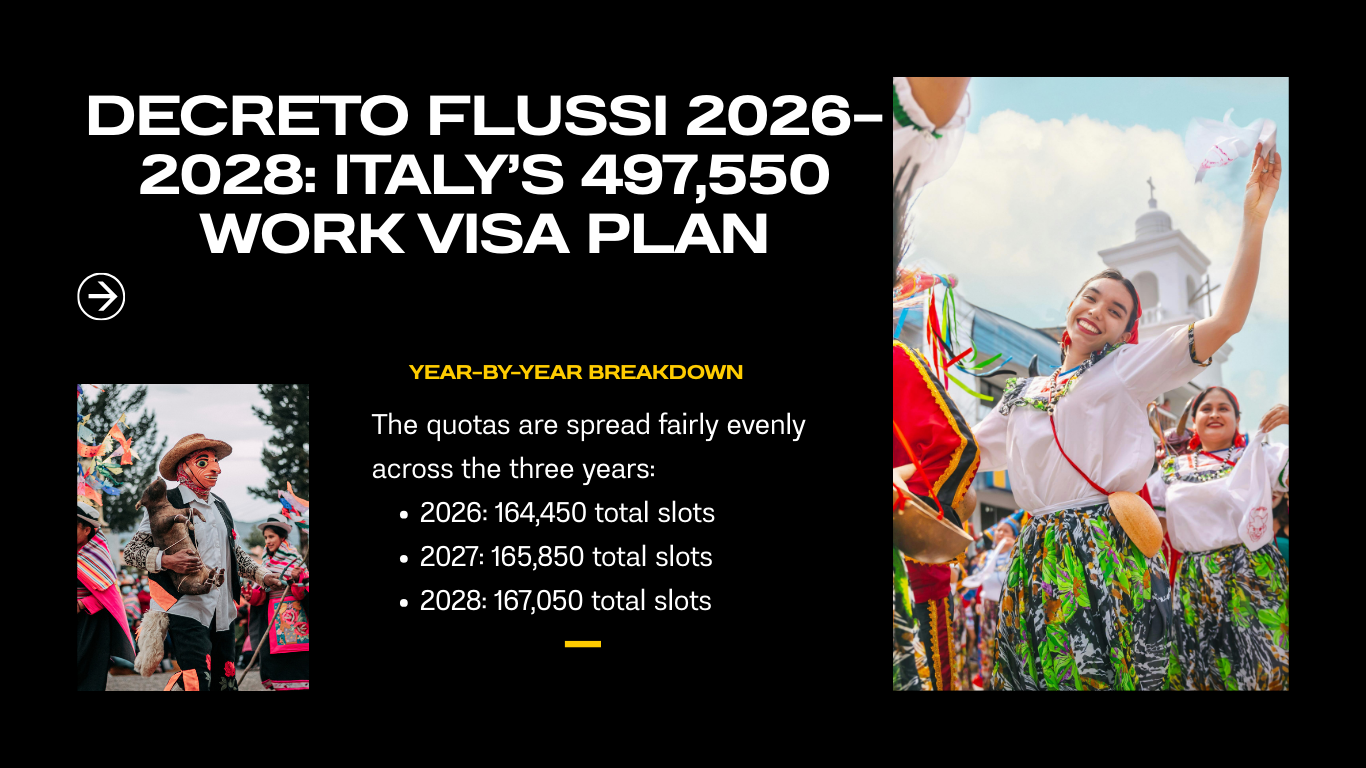
The quotas are spread fairly evenly across the three years:
2026: 164,450 total slots
2027: 165,850 total slots
2028: 167,050 total slots
Each year includes allocations for non-seasonal jobs, seasonal work, and domestic care roles such as caregivers and housekeepers.
Which Jobs Are Covered?
The decree focuses on sectors where Italy faces persistent worker shortages. These include:
Agriculture: farm labour, harvesting, food production
Tourism and hospitality: hotels, restaurants, resorts
Construction and skilled trades: selected non-seasonal roles
Domestic and home care: carers, housekeepers
Approved self-employment: limited, regulated categories
Importantly, all entries must be employer-sponsored. Individuals cannot apply on their own without a job offer.
The Purpose Behind the Policy
Italy’s government has been clear about its goals. First, the decree aims to match real labour demand with legal migration. Second, it seeks to reduce undeclared work and exploitation. Finally, it supports cooperation with origin countries through training and lawful recruitment.
Therefore, the Flussi system is not a shortcut to Europe. Instead, it is a controlled labour programme tied directly to Italy’s economic needs.
How the Application Process Works
Although details can change year to year, the standard process follows these steps:
Employer application: An Italian employer submits a work request during the official application window.
Work authorisation: If approved, the employer receives authorisation to hire the foreign worker.
Visa application: The worker applies for a work visa at the Italian embassy or consulate in their country.
Entry into Italy: After approval, the worker enters Italy.
Residence contract: The worker signs a contract at the immigration office.
Residence permit: A permesso di soggiorno is issued, allowing legal work and stay.
Because quotas are limited, speed and accuracy matter once applications open.
What Is Happening to the “Click Day” System?
Traditionally, Italy used a “click day” model, where employers rushed to submit applications on a single day. This system has been widely criticised for being stressful and inefficient.
Under the 2026–2028 framework, the government has signalled plans to gradually reduce reliance on click days by:
Expanding visa channels outside strict quotas
Prioritising high-demand professional profiles
Supporting training programmes in origin countries
However, for now, click days still exist, and employers must follow official timelines.
Preferential Quotas and Partner Countries
Another key change is the introduction of preferential quotas. Some slots will be reserved for:
Highly qualified workers
Citizens of countries that cooperate with Italy on migration control
Countries with repatriation agreements and anti-smuggling efforts
This approach is meant to encourage legal pathways and discourage dangerous, irregular routes.
Public and Political Reactions
Business groups and industry leaders have largely welcomed the decree, citing labour shortages across key sectors. On the other hand, some political groups have criticised the plan, arguing it increases migration.
Despite mixed reactions, the Italian government maintains that the policy is data-driven and economically necessary, not an open-door system.
What Prospective Applicants Should Know
If you are considering this route, keep the following in mind:
You cannot apply without an employer
Quotas fill quickly
Preparation must start months in advance
Only official channels matter
No one can guarantee approval
As a result, caution is essential.
⚠️ Travelcliques Disclaimer & Scam Warning
Important: Travelcliques does not sell Italy work visas, provide job offers, or guarantee approvals under the Decreto Flussi. All work visas are employer-sponsored and issued solely by Italian authorities.
Be careful of:
Promises of “guaranteed” Italy work visas
Requests for upfront visa fees without a verified employer
Agents claiming they can bypass quotas or click days
Always verify information through official sources. Immigration decisions are made only by the Italian government.
Final Thought
The Decreto Flussi 2026–2028 is one of Europe’s largest legal labour-migration programmes. For eligible workers with genuine job offers, it provides a structured and lawful path into Italy. However, competition is high, rules are strict, and preparation is everything.
For updates, timelines, and verified travel information, continue to follow Travelcliques.